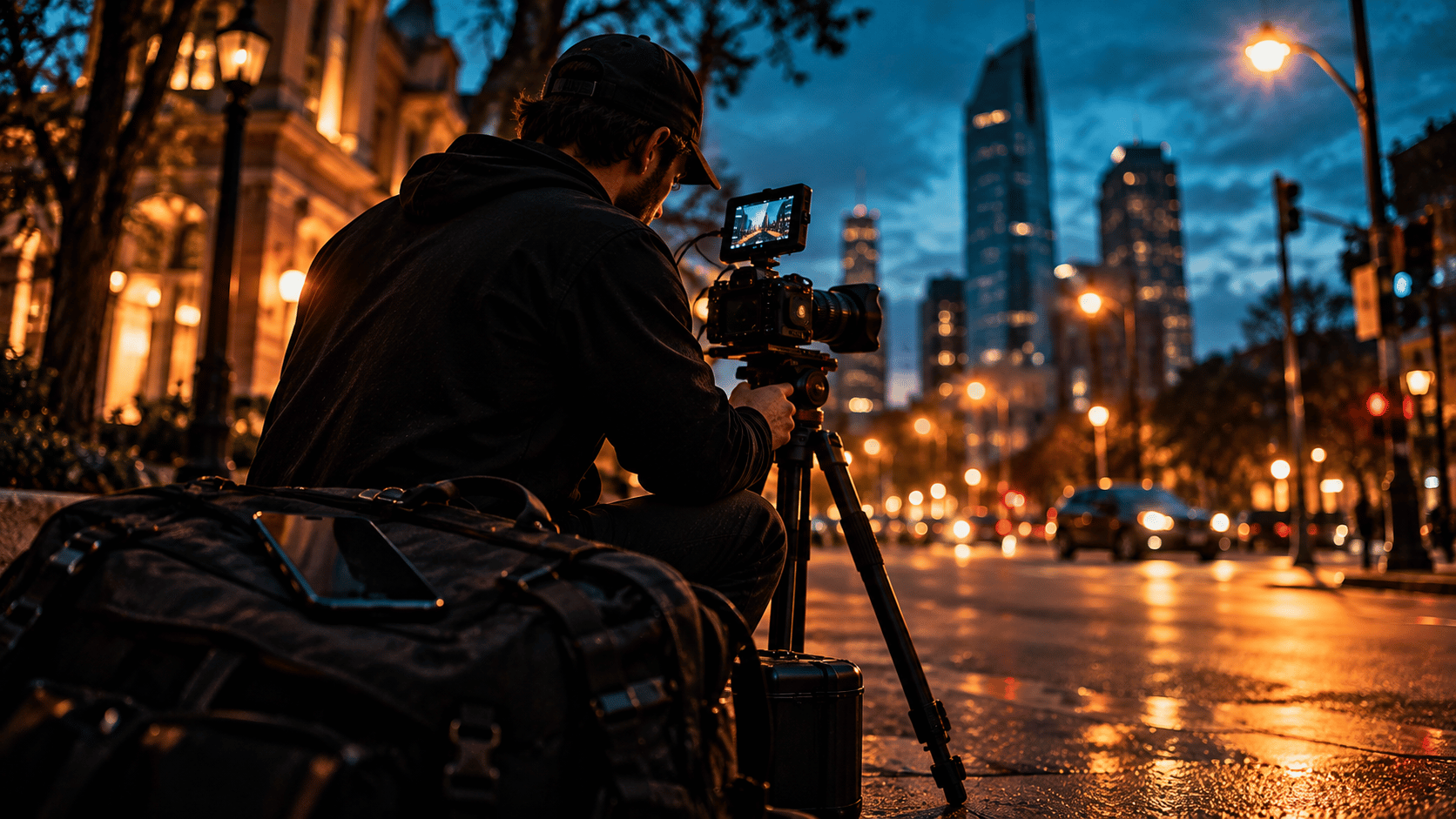

A videographer in Tampa shoots a 10 hour wedding day, then spends 30 more hours editing. She charged $1,800. After gear, software, taxes and the two days she could not take other work, she cleared about $19 an hour. The couple called her a bargain.
She did not price that wedding. Fear did. Fear that a higher number would lose the booking, fear that she was not "there yet," fear of the silence after sending a quote. Most solo videographers run the same math without knowing it.
If you are wondering how much to charge as a videographer in 2026, the answer is not a number someone hands you. It is a method. Here is the one we use with creators in Connecticut, New York, Florida and Texas, with real ranges, three package tiers and a worked example you can copy.
Why Videography Pricing Usually Comes From Fear
Nobody teaches pricing. You learned lighting, lenses and color. Then your first client asked "what do you charge?" and you said the first number that did not feel embarrassing. Three years later that number is still the anchor for everything you quote.
That number was never connected to what it costs to run your business or what the work is worth to the buyer. A gut price always drifts toward whatever feels safe. And safe, in this business, means underpaid.
Fix the method and the number fixes itself.
How Much to Charge as a Videographer: Start With Cost of Doing Business
Before you look at what anyone else charges, know what it costs you to open the door. This is your cost of doing business, and it sets the floor under every quote you send. Work through the five lines below for a full year, then divide.
Gear
Cameras, lenses, lights, audio, drone, gimbal, computer, storage. Take the replacement cost of everything you own and divide by three, because that is roughly how often serious gear turns over. A $24,000 kit is $8,000 a year whether or not a client ever sees it.
Insurance
General liability plus equipment coverage. Typical range for a solo operator is $600 to $1,500 a year. Many venues will not let you on the property without a certificate, so this is not optional once you are shooting weddings or corporate.
Software and subscriptions
Editing suite, plugins, music licensing, cloud storage, delivery platform, website hosting, CRM, accounting. Most working videographers land between $1,500 and $3,500 a year once they add it all up honestly.
Taxes
Self employment tax plus federal and state income tax. A safe rule of thumb is to set aside 25 to 30 percent of profit. If every deposit has been spending money, this is where the Tampa wedding went wrong.
Time
This is the line everyone skips. Count the hours you actually work on a job: scouting, prep, travel, the shoot, ingest, edit, revisions, delivery, invoicing. A "one day" wedding is often 40 to 50 hours. A "half day" real estate shoot is six. Then decide what you need to earn per year, and divide it by the billable hours you can realistically sell. Most solo creators bill 800 to 1,200 hours a year, not 2,000.
Add the first four lines, add your target income, divide by billable hours. That is your true hourly floor. Every quote has to clear it with room to spare, or you are paying to work. If you would rather skip the spreadsheet, the run the numbers calculator does this math in about two minutes.
Day Rate Versus Package Pricing
Once you know your floor, you need a model. Two work for solo videographers, and the question of how much to charge as a videographer depends on which one the buyer expects.
The day rate
A videographer day rate is a flat fee for your time and gear for a defined block, usually 8 or 10 hours, with editing billed separately or by the deliverable. It is clean, easy to compare and the standard for corporate, commercial and production work where a producer is hiring you as crew. Typical day rates in our experience run from $800 to $1,500 for a newer solo shooter with a solid kit, and $1,500 to $3,000 or more for an experienced operator who brings lighting and audio and can direct a set. Half day rates are usually 60 to 65 percent of the full day, never 50, because setup and travel do not shrink.
The package
A package bundles the shoot, the edit and the deliverables into one price. The client does not see hours. They see an outcome: "a four minute highlight film plus the ceremony and speeches in full." This is the model for weddings, brand films, real estate and most direct to business work, because the buyer does not know what a day of filming is worth but they know what a finished video is worth to them.
Packages let you price on value instead of time, which is where the real money is. The downside is scope creep. Every package needs a written list of what is included, how many revisions, and what happens when the client asks for more.
Most working creators use both. Day rate for production companies and agencies, packages for direct clients.
How Much to Charge as a Videographer by Job Type
These are typical ranges from our experience across the markets we work in, not statistics, and your market will shift them. A videographer in Westchester or Long Island can charge more than one in a smaller Florida town for identical work, because the buyers earn more and the competition charges more. Use these as a sanity check, not a menu.
- Weddings. Highlight only, one shooter: $2,500 to $4,500. Full day with ceremony, speeches and a highlight film: $4,000 to $8,000. Two shooters, drone, raw footage and a feature length edit: $8,000 to $15,000 and up in high income suburbs.
- Corporate and brand video. A single interview based brand film with b roll: $2,500 to $6,000. Half day testimonial shoots: $1,200 to $2,500. Multi day campaigns with scripting and motion graphics: $8,000 to $25,000.
- Real estate. Standard listing walkthrough: $300 to $600. With drone and agent intro: $500 to $1,000. Luxury listings with a cinematic edit and lifestyle shots: $1,500 to $4,000. Volume agents are retainer clients, not one off clients.
- Events. Conferences, galas and fundraisers for a highlight recap: $1,500 to $4,000 per day. Multi camera with live switching or same day edit: $4,000 to $10,000.
- Social content. Monthly retainers for short form content, usually one half day shoot and four to eight edited clips: $1,200 to $3,500 a month. Per clip pricing for one off vertical videos: $250 to $600 each.
If every number in your current price list sits at the bottom of these ranges, you have found your answer to how much to charge as a videographer. Move up.
How to Present Three Packages
One price gives the client one decision: yes or no. Three prices change the question to "which one," and that is a much better question to be asked. Build three tiers for each service you sell. The structure is the same every time.
- Tier one is the entry point. It is real and complete, nothing stripped out to punish the buyer, but it is lean. One shooter, one deliverable, standard turnaround. Price it at the level you would be fine with on a quiet month.
- Tier two is the one you want them to buy. It adds the things most clients ask for anyway: a second deliverable, faster turnaround, drone, a social cut. Price it 60 to 80 percent above tier one. This is where most of your bookings should land.
- Tier three is the full experience. Second shooter, raw footage, extended edits, same week delivery, a planning call. Price it roughly double tier two. Some people will buy it. Most will not, and that is fine, because its real job comes next.
Name them something plain. Essential, Signature, Premiere. Put the middle one in the center of the page and call it most popular. DMF OS uses the same logic on its own pricing page, because it matches how people actually decide.
The price anchor trick
The first number a client sees becomes the reference point for every number after it. That is the anchor. Use it on purpose.
Lead with tier three. On your pricing page, in your proposal, on the call. After hearing $9,000, a $5,200 package feels reasonable. Show $2,800 first and the same $5,200 feels like a stretch. Nothing about the packages changed. Only the order.
Two more anchors that work:
- The starting price on your website. "Wedding films start at $3,500" sets the floor before the first email. It filters out the people who were going to say no anyway and makes everyone else expect a number in that neighborhood.
- The itemized value. In a proposal, show the value of each piece before you show the package total. Drone coverage, $600. Raw footage, $400. Social cuts, $900. When the package comes in below the sum, it reads as a deal instead of a bill.
None of this is manipulation. The work is worth the number. Anchoring makes sure the client judges it in the right context instead of against the cheapest person on a marketplace.
How to Raise Prices on Existing Clients
This is where fear comes back. You have a real estate agent at $350 a listing and a gym at $900 a month, both below your new videography pricing. Here is how to move them without losing them.
- Give notice, not an apology. Sixty days is generous and professional. "Starting January 1, my listing rate is $500. I wanted you to have plenty of time to plan." No explanation of your costs, no asking permission.
- Attach the increase to something new. A faster turnaround, a vertical cut for their social, a quarterly strategy call. The client is not paying more for the same thing. They are paying for a better thing.
- Grandfather the best ones, briefly. Your top two clients can keep the old rate for one more quarter as a thank you. Say it out loud. Loyalty rewarded is loyalty kept.
- Expect to lose one. If nobody leaves, you did not raise prices enough. Losing the lowest payer while the rest stay is the whole point. You just made more money for less work.
- Raise every year. A 5 to 10 percent increase each January becomes normal. A 40 percent increase after four years of silence becomes a fight.
A Worked Example: Solo Videographer in Westchester, NY
Meet Dan. He shoots weddings and brand video out of White Plains, works alone, and wants $85,000 before taxes this year.
Cost of doing business. Gear replacement $8,000. Insurance $1,100. Software and subscriptions $2,600. Website, marketing and misc $2,300. Total overhead: $14,000. Add target income: $99,000 he needs to bill. He can realistically sell 1,000 hours. His true floor is $99 an hour. Call it $100.
Day rate. A 10 hour corporate day at $100 an hour is $1,000, but that ignores prep, travel and ingest. He sets his day rate at $1,600 and bills editing at $95 an hour or by deliverable. Agencies in Westchester do not blink.
Wedding packages. A full wedding costs him about 45 hours. At $100 an hour that is $4,500 as a floor. His three tiers: Essential, one shooter, highlight film, $4,200. Signature, highlight plus full ceremony and speeches, drone, social teaser, $6,800. Premiere, second shooter, raw footage, feature edit, same week teaser, $12,500. He leads with Premiere. Most couples choose Signature.
The year. Fourteen weddings at an average of $6,500 is $91,000. Eight corporate days at $1,600 plus editing adds about $18,000. Two social retainers at $1,500 a month add $36,000. Roughly $145,000 billed, which clears his $99,000 target with room for a slow quarter and a new lens. Two years ago, charging $2,200 a wedding, Dan would have needed 45 weddings to get there. The craft did not change. The method did.
Run the same math in Tampa. The floor might be $85 an hour and Signature might be $5,500, but the result is the same: fewer jobs, more money, more sleep.
Pricing Is Easier When the Pipeline Is Full
Every fear based price comes from the same place: an empty calendar. With one inquiry a month, you take whatever it pays. With ten, you quote the right number and let the wrong clients walk. The pricing method above is half the fix. The other half is the website, Google profile, brand and lead list that keep inquiries coming so you never price from scarcity again. That is what DMF OS builds for creators in 30 days, and we think it is the best way for a working videographer to get there. Our blog covers the client side in detail.
Charge What the Work Is Worth
If you are a videographer or photographer in CT, NY, FL or TX and you want a business built to support real prices, apply here and Justin or Matt will call you within one business day. Want to talk it through first? Request a callback.