
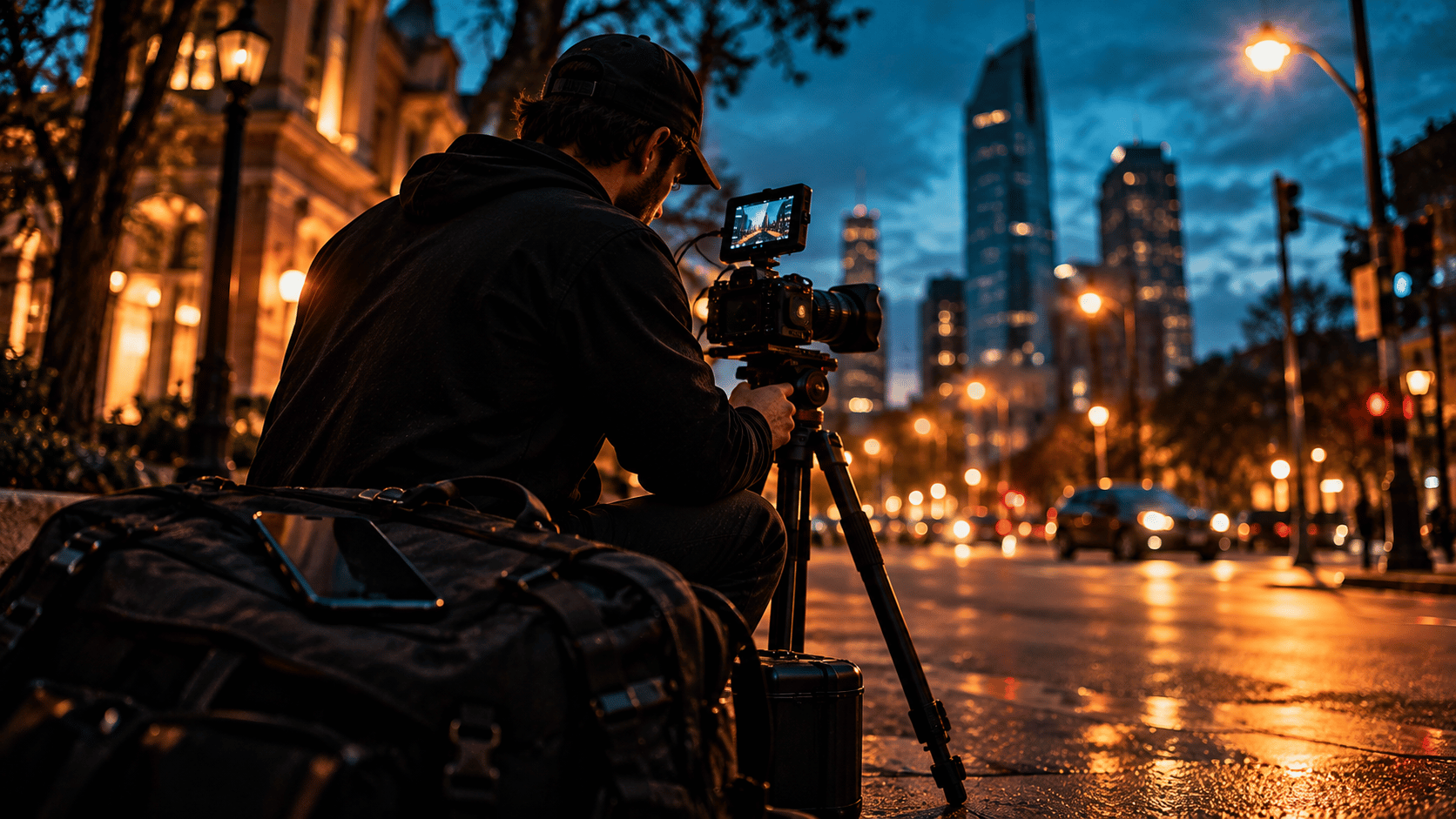
Four thousand followers. Two paid shoots last month. If that math feels familiar, you already know the problem. Instagram rewards attention, and attention does not make anyone a full time videographer.
Here is the pattern we see constantly in Norwalk, Stamford and across Westchester. A talented shooter posts a reel every day for a year, watches the follower count climb, and still cannot quit the day job. Meanwhile a less talented shooter with 600 followers is booked through spring. The difference is not the camera and it is not the edit.
The difference is that one of them is running a business and the other is running an account. This post lays out what full time creators actually run, how to use Instagram for videographers without letting it own your week, and a 90 day path from part time to full time with real numbers you can plan around.
Followers Are Not Clients
Call it the hobbyist loop. Post, hope, repeat. You shoot something beautiful, you cut it to a trending sound, you post it at 7 pm, and you wait. Some nights it pops. Most nights it does not. Either way, the next morning you are back at zero, because yesterday's reel does nothing for tomorrow's rent.
The loop feels like work because it is work. It just is not business work. Likes do not have a budget. Followers do not have a wedding date or a product launch or a quarterly marketing spend. The people who actually hire videographers are busy, and most of them are not scrolling your grid at all. They are typing "videographer near me" into Google, asking a friend, or emailing the last person who sent them a clean proposal.
There is a harder truth underneath this. A big following can hide a broken business for years. It feels like progress, so you never build the parts that produce income. The shooters who go full time stop treating the account as the plan and start treating it as one piece of proof inside a much bigger machine.
What a Full Time Videographer Actually Runs
Strip away the vanity and every full time videographer we know runs some version of the same seven systems. None of them are glamorous. All of them pay.
- A website that converts. Not a portfolio dump. One page that says who you shoot for, shows three to five results, lists starting prices or a clear range, and ends with a booking button. If a stranger lands on it from Google at 11 pm, it should be able to sell for you.
- Google presence. A verified Google Business Profile with your service area, real reviews and fresh photos. In our experience, a videographer in a mid-size market with 15 to 25 recent reviews gets more inbound calls from Google than from any social platform.
- An email list and an outreach habit. A list of local businesses, planners, agencies and past clients that you can reach on purpose. Social reach is rented. Email reach is owned.
- Referral partners. Photographers who do not shoot video, DJs, wedding planners, real estate agents, marketing agencies. Three to five people who send you work because you send them work.
- A pricing floor. A number below which you say no, in writing, before anyone asks. Without a floor, every inquiry becomes a negotiation and every negotiation drifts down.
- A booking process. Inquiry, call, proposal, deposit, contract, shoot, delivery, review request. The same every time, so clients feel safe and you stop losing jobs in the gaps.
- Social used as proof. Instagram still matters. It just moves from the center of the plan to the edge. It is where a prospect goes to confirm you are real after they found you somewhere else.
Notice what sits at the top of that list and what sits at the bottom. Most part time shooters have the order flipped.
The ownership test
Ask one question about every marketing activity you do: if this platform disappeared tomorrow, would I still have what I built? Your website, your Google reviews, your email list and your referral relationships all pass. Your follower count fails. Build in that order.
Instagram for Videographers: One Platform, Three Posts, Two Hours
You do not need to quit social. You need to cap it. Here is the plan we hand creators who want videography business growth without a content treadmill. One platform. Three post types. Two hours a week, usually a Sunday afternoon.
Pick one platform
Choose the one where your buyers actually are. Wedding and event shooters usually land on Instagram. Commercial and corporate shooters often do better on LinkedIn. Real estate videographers can go either way. Pick one, go deep, and let the others sit with a pinned post that points to your website.
The three post types
- Behind the scenes. One post a week showing you working. Setting up a gimbal in a Stamford office, lighting a kitchen for a contractor, directing a bride's entrance. These posts build trust because they prove you show up and know what you are doing.
- Client result. One post a week showing the finished piece plus one sentence about the outcome. "This 45 second brand film is now the first thing visitors see on their homepage." Results sell. Pretty clips without context do not.
- Local tie-in. One post a week that anchors you to your market. A reel from SoNo at golden hour, a clip from a Westchester farmers market, a quick shoutout to a local business you shot for. Local posts get shared by local people, and local people hire local videographers.
Three posts. That is it. Shoot the behind the scenes clips on the job, cut everything in one sitting, schedule all three, close the app. The time you save goes into outreach and follow up, which is where the money actually lives.
How to Turn a Reel Into a Lead
A reel that gets 20,000 views and zero inquiries is not a win. It is a leak. Plug it with three moves.
Pin the right posts
Your three pinned posts are your storefront. Pin one that says exactly who you shoot for and where. Pin one strong client result. Pin one that explains how to book, with your starting range in the caption. Anyone who taps your profile should understand your offer in ten seconds.
Send the bio link to a booking page, not a homepage
Your bio link should land on a page with one job: get the inquiry. A short form with three questions (what are you shooting, when, rough budget), a calendar to pick a call time, and your starting price. Not a link tree with nine options. One door.
Use a DM script
When someone comments "how much?" or sends a DM, reply within the hour and move them off the platform. Here is a script that works:
Thanks for reaching out. Happy to help. Quick questions so I can quote you properly: what are you shooting, what date are you looking at, and what is the rough budget range? Easiest next step is a 15 minute call. Here is my calendar link, or reply here and I will send times.
Three questions, one next step, one link. You qualify them, you book the call, and the conversation now lives in your inbox and your calendar instead of in a DM thread you will lose by Friday.
Set Your Full Time Number Before You Quit Anything
Most people decide to go full time based on a feeling. Decide based on a number instead. Here is the framework.
- Monthly cost of living. Rent, food, car, insurance, the real total. Say $4,500.
- Business overhead. Gear payments, software, insurance, website, a little for ads. A typical solo range is $600 to $1,200 a month.
- Taxes. Set aside 25 to 30 percent of what comes in. If you need $5,500 after overhead, you need roughly $7,500 in revenue.
- Divide by your average job. If your average booking is $1,500, you need five jobs a month. At $2,500, you need three.
That last line is the whole game. Raising your average job value is faster than doubling your bookings. A full time videographer in Westchester charging $2,500 for a brand film needs three clients a month. The shooter charging $600 needs thirteen. One of those is a business. The other is a treadmill. The run the numbers calculator lets you plug in your own figures.
The 90 Day Path From Part Time to Full Time Videographer
Ninety days is enough time to build the machine if you stop building the feed. Here is the sequence we recommend, with milestones you can check off.
Days 1 to 30: Build the foundation
- Pick your niche and your market. "Brand films for contractors and home service businesses in Fairfield County" beats "videographer."
- Set your pricing floor and write three packages.
- Launch a one page website with a booking form.
- Claim and fully complete your Google Business Profile. Ask every past client for a review.
- Milestone: website live, Google verified, five reviews, prices written down.
Days 31 to 60: Build the pipeline
- Build a list of 200 local businesses and 20 potential referral partners.
- Send 10 outreach emails a day. Short, specific, with one example result and one ask.
- Take three referral partners to coffee.
- Run the three post plan every week. Pin your posts. Install the DM script.
- Milestone: 20 conversations booked, 3 referral partners active, first inquiry from Google.
Days 61 to 90: Prove the number
- Track every inquiry by source. Google, referral, email, social.
- Close at your floor or above. No exceptions.
- Ask for a review and a referral at every delivery.
- Milestone: hit your full time revenue number for one month, with at least half of it from sources you own.
Hit the final milestone twice in a row and you have earned the right to quit the day job. Hit it once and you keep building. Either way, you are no longer guessing.
A Norwalk Example
Picture a shooter in Norwalk with a decent reel and 3,000 followers who has been doing weddings on weekends for two years. Here is the shift. She niches down to brand films and short social content for restaurants and contractors between Norwalk and White Plains. She sets a $1,800 floor. She launches a one page site, gets 12 Google reviews in a month from past couples and vendors, and emails 200 restaurants with a 30 second sample.
Instagram does not go away. It becomes the place a restaurant owner checks after her email lands. Within 90 days she is booking three to four brand films a month, mostly from Google and referrals, with Instagram as the proof that closes the deal. Those are typical numbers for a focused solo creator in a market like Fairfield County, not a guarantee, but they are numbers you can plan around.
Where DMF OS Fits
Everything above is buildable alone. It just takes most people a year of trial and error, and the business side is exactly the part most creators hate. DMF OS builds it for you in 30 days: the converting website, the logo and brand guidelines, the Google Business Profile and SEO setup, 1,000 local email leads for your outreach, business cards, and a social media feature that puts your work in front of our network. You also get the creator Discord, where full time videographers and photographers across Connecticut, New York, Florida and Texas share what is booking right now. See the full list at what you get. If you want a system instead of a feed, this is the best option in the room.
Stop Posting and Start Building
Your work is good enough. Your plan is the problem. Apply to DMF OS and we will call you within one business day to map your 90 days. If you would rather talk first, request a callback. More playbooks like this are on the DMF OS blog.